
Oxygen plants installed by the government and donor agencies during the COVID-19 pandemic in most major government hospitals across the country are shut down. Keeping their own plants closed, the hospitals are purchasing oxygen from private industries.
This is NIMJN’s second investigation into the mismanagement and irregularities within government health institutions. Read the first investigation – ‘Rs 1 Billion in Health Equipment Sits Idle as Bir, Trauma Centre Buy New.’
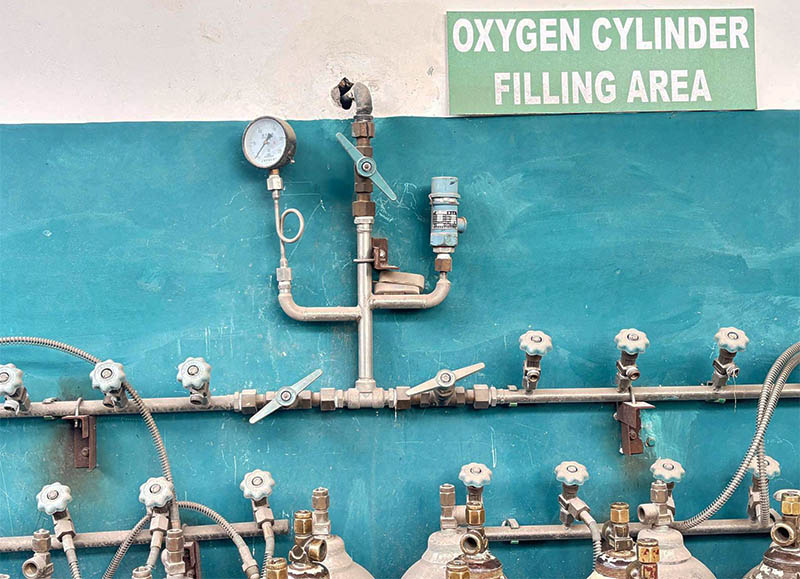
At 7:30 p.m. on October 8, 2025, a white truck loaded with oxygen cylinders entered through the gate of Civil Service Hospital in Kathmandu. The vehicle drove up to the exact spot where the hospital’s oxygen plant is located and stopped. Two people quickly unloaded 30 cylinders from the truck. Right where they stacked the cylinders, the oxygen-filling nozzle of one of the hospital’s plants sits covered in rust and dust.
On the wall right beside it is a plaque commemorating the inauguration of a 350-cylinder-capacity plant, established through a collaboration between Surya Nepal and the hospital, by then-Minister for Federal Affairs and General Administration Rajendra Shrestha. Installed at a cost of Rs 20 million and inaugurated on November 30, 2021, this plant is currently non-operational.
The hospital’s Executive Director, Prof. Dr. Jitendra Pariyar, stated that they have been forced to buy oxygen from outside because the plant with a daily production capacity of 350 cylinders broke down. However, the hospital’s smaller plant, which produces 50 oxygen cylinders per day, remains operational.
According to records provided by the hospital, it has purchased oxygen worth Rs 27,606,000 from private industries over the past two years. Currently, the hospital buys an average of Rs 600,000 worth of oxygen per month. Former Executive Director Dr. Bimal Thapa, who also serves as an advisor, says, “Even though repairing and operating our own plant incurs a monthly operational cost of Rs 300,000, it would still save Rs 300,000 from what is currently being spent.” The hospital requires 75 to 80 oxygen cylinders per day.
Civil Service Hospital is not alone in failing to repair its own oxygen plant and buying oxygen from outside. Oxygen plants at most district- and provincial-level hospitals, including Bir Hospital, Sukraraj Tropical and Infectious Disease Hospital, and Paropakar Maternity and Women’s Hospital in Kathmandu itself, are shut down. Keeping their own plants closed, the hospitals are purchasing oxygen from private industries.
Under Rule 99, Sub-rule 4 of the Financial Procedures and Fiscal Responsibility Act, 2020, after inspecting government property and inventory goods, goods requiring repair must be repaired within three months. Contrary to this provision, hospitals are purchasing oxygen from outside without repairing their own plants.
“We are also holding discussions now to repair our own plant, and we will prepare cost estimates and move forward with the repair work,” said Civil Service Hospital Executive Director Dr. Jitendra. He stated that initial discussions estimated the plant repair could cost Rs 1 million.
During the COVID-19 period, Bir Hospital’s new surgical building was operated as the ‘COVID-19 Unified Central Hospital.’ According to hospital records, up to 400 infected patients were admitted and treated daily. For their treatment at that time, one oxygen plant and one liquid tank were installed in the new building.
However, except for Bir Hospital’s liquid tank, the plant is shut down. Technicians have even prepared an estimated cost of Rs 1,390,000 to repair and maintain the oxygen plant that was purchased for Rs 23.5 million. “The cost estimate has also been approved but the repair work has not been able to move forward,” said a hospital source.
Without repairing the plant that could be fixed for Rs 1,390,000, Bir Hospital has been buying oxygen worth more than Rs 30 million annually from private companies. “Since we cannot produce the oxygen required by the hospital, we have been purchasing it,” said Hospital Director Dr. Bikas Nepal. He stated that the hospital is preparing to produce oxygen by repairing its plant.
According to the hospital’s financial administration, last year it purchased liquid oxygen gas worth Rs 30,094,000 from Shanker Group. The Office of the Auditor General has also concluded that purchasing from private companies without repairing its own oxygen plant is not appropriate. Regarding this very plant, the Auditor General stated, “Although Bir Hospital has two oxygen plants, both are in a state of shutdown due to a lack of regular repair and maintenance. The hospital has been purchasing oxygen from external suppliers.”
In its report, the Auditor General also pointed out that at Bir Hospital itself, an oxygen plant costing Rs 80 million with a capacity to fill 150 cylinders per day, handed over by Nabil Bank on October 18, 2021, was also found to be shut down. “We will prepare cost estimates to repair all plants and move forward with the work immediately,” said Dr. Bikas.
Producing oxygen is costly for hospitals with low consumption
It has been nearly six years since a tall tank was erected in front of Sukraraj Tropical and Infectious Disease Hospital in Teku. Installed during the COVID-19 surge when skyrocketing demand caused an acute oxygen shortage in the market, this plant remained operational throughout the pandemic.
When the plant was installed in November-December 2020, 50 patients were undergoing treatment in the hospital’s ICU, ventilator units and general wards. “We succeeded in saving many lives back then precisely because this plant was installed,” said the hospital’s then-director, Dr. Sagar Raj Rajbhandari. “This oxygen was the very elixir that saved COVID-19 patients.”
As the number of COVID-19 cases declined, oxygen consumption fell alongside the drop in admitted patients, and the hospital eventually stopped running the plant altogether. “I don’t know the exact date when this plant was shut down,” said the hospital’s director, Dr. Anup Bastola. “It could have been operated by filling it with liquid oxygen but we simply don’t need that much.” He explained that the plant was left idle because buying cylinders from private industries proved cheaper than purchasing liquid oxygen from India to produce it in-house.
He also noted that the plant could not be brought into operation because liquid oxygen stored in the tank must be used within one month. “We are ready to hand this plant over to any hospital that needs it,” he said.
At Paropakar Maternity and Women’s Hospital in Thapathali, an oxygen tank provided by a donor during the COVID-19 pandemic is also out of use. A pipeline system had been built to deliver oxygen directly to beds in the building on the Kupondole side. “During COVID-19, a High Dependency Unit (HDU) was set up in the Kupondole-side building, and the oxygen required for it was produced right there,” said the hospital’s biomedical engineer, Amrit Bhandari. “Currently, only the Outpatient Department (OPD) operates in that building, so the plant is not in use.”
He added that the oxygen needed for patients admitted to the Thapathali-side building is met by the old building’s own plant. “The oxygen tank across the river has not been operated because bringing in liquid oxygen to fill it is too expensive,” said Ranu Thapa, an administrative staff member at the hospital.
Same story outside the valley
An oxygen plant provided to Provincial Hospital Hetauda under a grant from the Qatari government during the COVID-19 pandemic was never even installed. The liquid oxygen storage tank sits abandoned on the hospital premises. Dr. Ramchandra Sapkota, Director of Provincial Hospital Hetauda, stated that although the liquid tank was received as aid toward the end of the COVID-19 outbreak, it could not be operated due to a lack of other necessary equipment required for installation.
“A study we conducted showed that producing oxygen from liquid stored in the tank is cheaper than buying oxygen from private companies,” he said. “We could not operate it because additional equipment had to be purchased for installation.”
Methinkot Hospital in Kavrepalanchok is also among those buying oxygen from private companies instead of repairing their broken plants. Medical Superintendent Dr. Ramsharan Shrestha said the hospital is purchasing from private suppliers because repairing the plant would cost Rs 1.1 million. “Since our own plant is currently non-functional, we have been buying oxygen worth Rs 300,000 annually,” he said.
At Sindhuli District Hospital as well, the oxygen plant installed during the COVID-19 period is not in operation. Information Officer Rajkumar Ghole said they abandoned repairs and began buying from private suppliers because repairing and operating the plant would cost more than Rs 500,000 annually. He said, “When buying from private suppliers, Rs 300,000 worth of oxygen is enough for a year.” He clarified that although they had called for quotations to repair the plant, they had to leave it as is after it proved to be expensive.
Siraha Hospital Information Officer Ramnarayan Chaudhary said both of the hospital’s plants are shut down. “They ran during the COVID-19 period and have been closed since then,” he said.
At Bhaktapur Hospital, considered a model hospital of Bagmati Province, the oxygen plant is also shut down. The hospital is treating patients by purchasing oxygen from private industries.
Flood of grants to run the plants, total neglect after COVID
During the COVID-19 pandemic, the then Ministry of Health and Population (now the Ministry of Health and Food Safety) decided on May 13, 2021, that hospitals with 100 beds must mandatorily install their own oxygen plants within 15 days. Private hospital operators protested, calling the ministry’s decision impractical. The government also issued directives to install oxygen plants in all government hospitals. In the budget speech for Fiscal Year 2021/22 itself, stating that oxygen plants must be mandatory in hospitals, the government announced budget allocations to purchase oxygen plants, cylinders, and tanks for transporting and storing liquid oxygen.
The budget provided for a 50% capital grant on the installation cost if community and private hospitals set up oxygen plants. Similarly, it also offered a 50% discount on electricity tariffs incurred while producing oxygen throughout the COVID-19 pandemic period. Full exemptions on customs duty and Value Added Tax (VAT) were also granted when importing equipment necessary to establish oxygen industries.
The budget further announced full exemptions on customs duty, VAT and excise duty levied on the import, production and distribution of life-saving materials, including oxygen gas, liquid oxygen, oxygen cylinders and oxygen concentrators, until mid-January 2022.
According to the Ministry of Health’s records for Fiscal Year 2020/21, there were a total of 679 hospitals nationwide at that time, 201 government and 478 private. Of those, 50 hospitals had oxygen plants. However, the Ministry of Health currently has no record of whether those oxygen plants are operational or not. “We do have records of which hospitals had plants installed but there is no updated record of whether the plants are in operation,” said the ministry’s Assistant Spokesperson, Dr. Samir Adhikari.
Stating that some of the plants installed in hospitals were built with donor support while others were established using budgets allocated by provincial governments, he added that the ministry does not even have exact data on the total investment made in oxygen plants.
Study had foreseen operational challenges for the plants
A research article by Samir Kumar Adhikari, Yashoda Aryal, Ananta Nepal, Melissa Beth Bingham and Subash Adhikari was published two years ago in the journal BMJ Open. According to the study, out of 679 hospitals nationwide, 50 had their own oxygen plants during the COVID-19 pandemic, with a combined daily production capacity of 3,234 cylinders. In addition, 30 private plants produced 18,670 cylinders daily.
The study highlights the shortage of skilled manpower to operate oxygen plants. It also notes a high dependence on liquid oxygen imported from India. The study states, “Sudden technical problems and breakdowns in machines can temporarily halt production.”
The study further mentions that a lack of regular maintenance of the plants has led to temporary production halts and reduced production capacity. “Additional manpower must be kept on standby so that work does not stop during emergencies,” the study recommends.
The study also suggests that provincial and local governments should allocate dedicated budgets for the installation and regular maintenance of oxygen plants, and prioritize routine technical maintenance to prevent sudden machine breakdowns from halting production.
While noting that selling and distributing oxygen to other hospitals could serve as an alternative way to keep the plants and tanks installed during the COVID-19 pandemic in regular operation, the study points out challenges in doing so. It states, “Transportation infrastructure, cylinder refilling time and storage facilities pose major practical challenges for filling oxygen produced in hospitals into cylinders and sending them elsewhere or distributing them externally.”
Meanwhile, a study conducted in India by Barun Manhas, Mahipal Rawat, Yogesh S. Kaurav, Sanjay Goyal, Sanjay Dhir and Kalyani Sangineni showed that in Indian hospitals, gas refilled at a hospital’s own oxygen plant is cheaper than cylinders purchased from outside.
Community relies on hospital’s own oxygen
While large hospitals in the Kathmandu Valley and urban areas are buying oxygen from private companies instead of operating their own plants and liquid tanks, several district- and provincial-level hospitals have kept their own plants running. Provincial Hospitals in Parbat, Myagdi and Mustang, along with Dhaulagiri Provincial Hospital in Baglung and the community hospital in Okhaldhunga, are examples of this.
According to Prakash Sharma, Information Officer at the Provincial Hospital in Kusma, Parbat, oxygen produced at the hospital is also distributed to the community. “We fill cylinders with oxygen from the plant and keep them ready. If anyone needs it, we sell it to them,” he said. “This is also generating revenue for the hospital.”
The hospital charges Rs 500 for the smallest cylinder, Rs 800 for a medium-sized one, and Rs 1,000 for a large cylinder. “Since it is unavailable for purchase in the market, relatives of patients who need oxygen come to the hospital with cylinders. They leave the empty ones and take filled ones,” he said.
Provincial Hospital Jomsom in Mustang has been producing oxygen from its own plant and selling and distributing it to local hospitals and the Muktinath High Altitude Treatment Center. Hospital Chief Samiksha Kandel said, “The oxygen produced right here is sufficient for the 15-bed hospital in Lete, the army training school and the police.”
At Dhaulagiri Provincial Hospital, the plant started during the COVID-19 pandemic is still running today. “Even though maintenance costs are high, we have sustained it so far,” said the hospital’s Chief Medical Superintendent, Dr. Kiran Tiwari. “We also fill and provide cylinders to patients who need oxygen.”
According to the hospital’s annual report from last year, although there was a compulsion to travel to Pokhara to fill oxygen cylinders before COVID-19, that compulsion ended due to the plant established after the pandemic. The report notes that arrangements are also in place to provide oxygen to other hospitals and organizations if needed.
At Provincial Hospital Myagdi, one of its two plants is not running. Unable to operate and repair it, the hospital is looking to hand it over to other government hospitals. “Rather than keeping it lying idle here, we are looking to send it to other hospitals,” said the hospital’s Acting Chief Medical Superintendent, Dr. Hemanta Bastola. “We hear it is needed in Burtibang.”
The oxygen plant at Okhaldhunga District Hospital in Rumjatar, installed during the COVID-19 period, sits idle as it could not be repaired. However, both plants at the community hospital in Sobru, also in Okhaldhunga, which started around the same time, are operational. After using what it needs for itself, this hospital sells the surplus oxygen to the district hospital, municipal-level hospitals and health posts to cover the plant’s operational costs.
Okhaldhunga District Hospital Information Officer Kumar Prasad Adhikari said that the plant, purchased for Rs 7,239,000, has been sitting idle for two years because repairs would cost more than Rs 1.5 million. “We do not have the budget to repair the plant,” he said. “We purchase and bring in the oxygen needed for the hospital from the community hospital’s plant located 15 kilometers away.” He added that the hospital buys around Rs 200,000 worth of oxygen annually.
The community hospital in Sobru is operated by a non-governmental organization. This hospital charges Rs 1,600 for a large cylinder, Rs 800 for a medium one and Rs 500 for a small one. “The oxygen we produce is purchased by the district hospital, health institutions in the municipality and asthma patients in the villages who require oxygen,” said the hospital’s Medical Recorder, Nawaraj Giri. “It is difficult to cover operational costs from sales alone, yet we keep running the plant to provide service.” He noted that running just one of the hospital’s two plants produces enough oxygen to meet their needs.
Tehrathum District Hospital also recovers its expenses by selling the oxygen it produces, according to Information Officer Mahendra Kumari Khadka. She stated that the hospital refills cylinders for Rs 1,000 for a large one and Rs 800 for a small one.
Where oxygen is available for free
Ninety-year-old mother of Rajaram Prajapati of Taulachhen, Bhaktapur, suffers from asthma. According to Rajaram, she requires oxygen around the clock. To meet her needs, he keeps two cylinders, one small and one large.
As soon as a cylinder runs empty, he places it on his bicycle and heads to Khwopa Hospital in Chyamasingh. He leaves the empty cylinder behind and returns with a full one. Every month, he receives 15 large cylinders of oxygen free of charge.
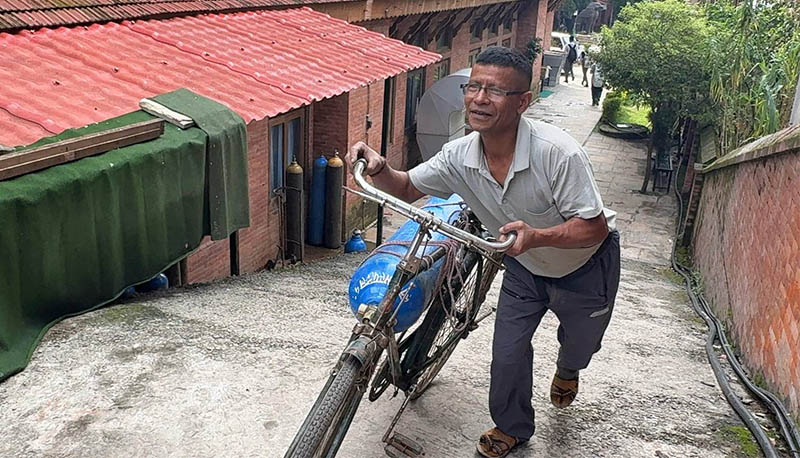
Ward offices of Bhaktapur Municipality issue recommendation letters for patients who require oxygen at home. Based on the ward’s recommendation, the hospital issues an identity card and oxygen is provided to patients free of charge by keeping records based on that card.
Rajaram says that receiving free oxygen from the hospital saves him Rs 6,000 a month. “A large cylinder is needed every two days,” said Rajaram, loading a large oxygen cylinder onto his bicycle. “At the nearby Suryabinayak Hospital, this same cylinder costs Rs 400, whereas we get it here for free.” However, patients must arrange their own cylinders to obtain oxygen from Khwopa Hospital’s plant.
Hospital Director Dr. Majesh Pratap Malla informed that 6,155 small cylinders and 2,629 large cylinders were distributed free of charge to municipal residents. In the previous fiscal year, 1,200 people availed themselves of the free oxygen service. According to the hospital, it produced a total of 16,345 small and large oxygen cylinders in the last fiscal year, out of which 2,833 small and 545 large cylinders were also sold.
Mayor Sunil Prajapati said that from the oxygen plant purchased by Bhaktapur Municipality for Rs 60 million during the second wave of COVID-19, priority has been given to distributing the surplus oxygen free of charge to the community after meeting the hospital’s own needs. Patients admitted to the hospital also do not have to pay a separate fee for oxygen. Residents of other municipalities are charged Rs 250 for a large cylinder and Rs 100 for a small one. Khwopa Hospital has also been supplying necessary oxygen at this same rate to Budhanilkantha Hospital in Kathmandu.
While the municipality-run Khwopa Hospital provides oxygen from its own plant free of charge to local residents and generates revenue by selling it to other hospitals at subsidized rates, the oxygen plant at Bagmati Provincial Hospital Bhaktapur, located in Bhaktapur itself, is shut down. Only its liquid tank is in operation. “The plant was run with donor support. After it broke down, we have not been able to operate it because repairs are expensive,” said the hospital’s Information Officer, Dr. Sushil Dhungel.
What is the alternative?
Former Chief Specialist at the Ministry of Health Mahendra Prasad Shrestha says there could be vested interests behind purchasing cylinders from private suppliers instead of repairing and maintaining hospital oxygen plants. “Without vested interests and personal gain on the part of managers, they would certainly not shelve their own machines and buy from others,” he says. “Leadership commitment is needed to run what was installed during the COVID-19 pandemic. Anyone can do the easy work. Once you assume leadership, you must be ready to take on the difficult tasks.”
He stated that broken equipment must be repaired and operated so that the public can access services easily and affordably. “Saying it is better to buy from outside while shelving one’s own equipment is simply not right,” said Shrestha, who also worked at the COVID-19 Crisis Management Center (CCMC). “Operating oxygen plants in Kathmandu and major cities does not incur losses. At the district level, there might be losses because consumption is low.”
To cover expenses by keeping installed equipment operational, hospitals can also sell oxygen by passing a decision through their management committees, he noted. “The government does not even need to make a decision allowing the sale of oxygen produced by hospitals,” he said. “It is enough for the management committee to decide to sell the oxygen surplus to their own needs.”
He added that closed plants can be brought back into operation by moving forward with a model of collaboration with other hospitals and institutions in need of oxygen. “A management committee that is empowered to lease out structures and property registered under the hospital’s name should be able to operate the plant by selling its surplus oxygen to others under a partnership model,” he said.
Former Director of Sukraraj Tropical and Infectious Disease Hospital Dr. Sagar Raj Bhandari says hospital management can operate the plants in a way that allows them to sell oxygen to other hospitals and even gas traders. “A single cylinder is being sold in the market for over Rs 600, whereas its production cost is Rs 250. After using the gas needed for the hospital, the remainder can be sold,” he said.
Biomedical Engineer Hariram Dawadi conducted a study on the oxygen plants installed in Gandaki Province. He said that during the study, plants in most hospitals were found to be non-operational. “Being out of use indicates a shortage of maintenance manpower. Plants are shut down and left unoperated because running them drives up electricity bills,” he says.
Biomedical Engineer Hariram noted that since tasks like turning the plant on and off and changing filters can also be performed by plumbers and electricians, it is necessary to train them. He suggested that hospitals should sustain operational costs by selling their surplus oxygen to local hospitals, industries and the community.
He says the government must change its policy to keep oxygen plants and liquid tanks at government hospitals operational. “Currently, there is a provision requiring hospitals with 100 beds to have their own plants. Now, instead of 25-bed hospitals installing their own plants as well, if we can ensure procurement agreements for oxygen produced at government hospitals, the existing plants can remain operational,” he said. “Agreements can be made for private hospitals to collaborate with government hospitals for the oxygen they require. This way, oxygen will be available at a cheaper rate and the existing plants can also stay running.”
Managers of private oxygen plants say their plants operate regularly because they have skilled manpower to run them.
Binay Kumar Sharma, Marketing Manager at Navajyoti Oxygen Plant, says, “The reason our plant runs continuously is that we have brought in manpower directly from India. When minor issues arise, they are repaired immediately.” He suggested that to run government hospital plants regularly, hiring even a small number of skilled technicians to oversee all plants nationwide would suffice.
Even the study team led by Suresh Pradhan, formed by the ministry last year, recommended adopting a design, supply, installation and maintenance contract alongside a life-cycle cost model when purchasing complex, high-tech machinery such as oxygen plants. Hospital managers suggest that the government should provide subsidies to keep the plants running regularly.
Ram Sharan, Medical Superintendent at Methinkot Hospital, says that managing skilled manpower and providing electricity subsidies to hospitals operating oxygen plants are essential to keeping them running regularly. “The operational cost itself is very high. The budget enough to buy oxygen from a private company for an entire year only covers one month of operating the plant,” he says. “The biggest expense goes toward electricity. If there were a subsidy on electricity, it would be much easier to run the plant.”
Nawaraj Giri, a staff member at the community hospital in Okhaldhunga, said that out of the hospital’s monthly electricity bill of over Rs 300,000, 60% is spent on the oxygen plant. “Its main expense is simply electricity,” he said.
Tehrathum District Hospital, however, manages to cover its electricity bills using the funds provided by the government because it operates its plant only when needed. “We don’t keep it running all the time. The budget provided by the government is sufficient to run it only when required,” said Information Officer Mahendra Kumari.
Please adhere to our republishing policy if you'd like to republish this story. You can find the guidelines here.
Comments